
Key Takeaways
- MattDarm's current brand identity packages are £499, £999 and £1,999 excluding VAT. These are real published in-house prices, not claimed UK market averages.
- A logo is one part of an identity. A complete system can include colour, typography, imagery, graphic elements, templates, applications and guidelines.
- Compare the research, concepts, usable assets, rights and implementation support behind each quote.
- Ask which costs sit outside the identity project, including printing, website development, photography, packaging production and paid font or image licences.
- The best budget is the smallest scope that gives your business a coherent, usable system for the touchpoints it genuinely has.
Brand identity design prices are difficult to compare because suppliers use the same phrase for very different jobs. One quote may cover a logo, two colours and a PDF. Another may include strategy, a flexible identity, photography direction, presentation templates, website applications and a detailed rollout.
For a concrete answer, MattDarm currently publishes brand identity design packages at £499 for Logo & Basics, £999 for Full Identity and £1,999 for Premium Brand, excluding VAT. Those prices are our current offer for stated deliverables. They are not an invented average for every UK freelancer or agency.
This guide focuses narrowly on the cost of the visual identity system and how to assess a quote. If you need the wider picture covering strategy, websites and marketing, use our separate guide to branding costs in the UK.
Brand Identity Design Cost: Current MattDarm Prices
All prices below are in GBP and exclude VAT.
| Package | Price | Current published scope |
|---|---|---|
| Logo & Basics | £499 | Three logo concepts, two revision rounds, colour palette, font pairing, final logo formats and basic usage guidance |
| Full Identity | £999 | Logo & Basics plus a fuller guidelines document, business card, social templates, email signature, pattern or texture and unlimited revisions |
| Premium Brand | £1,999 | Full Identity plus strategy workshop, stationery suite, presentation template, marketing templates, asset library and broader production-ready files |
The packages answer different needs. A new sole trader with a small number of touchpoints may not require the same system as a growing company with a sales team, regular campaigns and several suppliers.
The published scope is the starting point. A naming project, extensive packaging range, custom illustration library, on-site photography or multi-brand architecture would need separate definition.
What Does “Brand Identity” Actually Include?
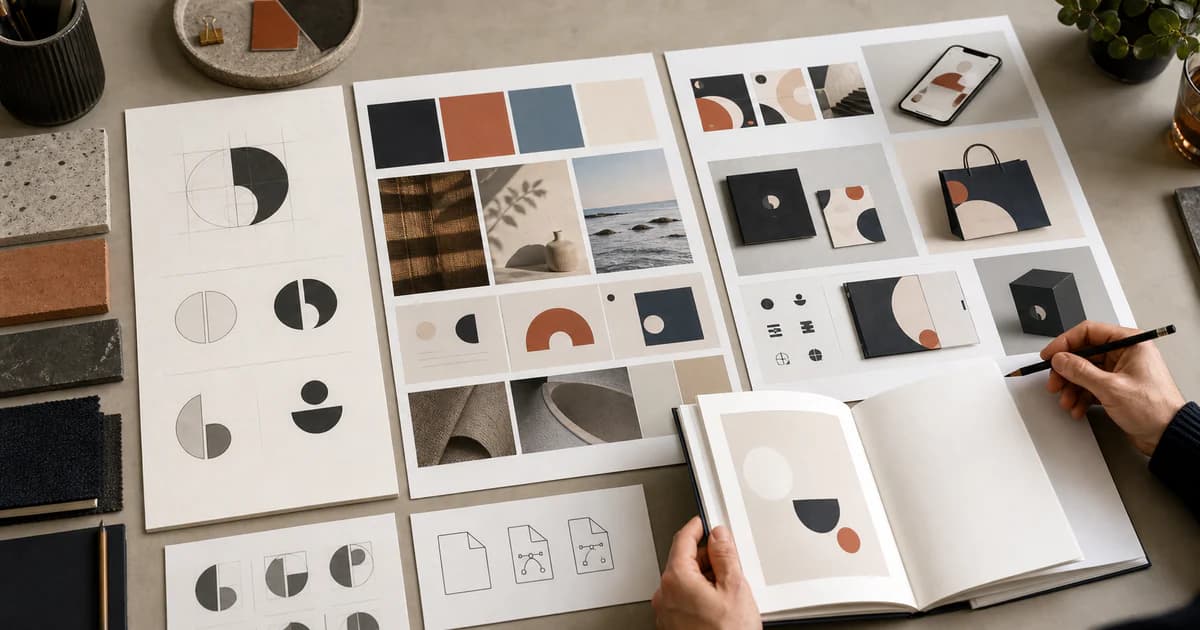
At its simplest, brand identity is the set of visual choices that makes a business recognisable. A useful system can contain:
- primary, secondary and compact logo variants;
- colour roles and accessible combinations;
- primary and supporting typefaces;
- hierarchy for headings, body text and data;
- photography or illustration direction;
- icon style;
- patterns, shapes or other graphic devices;
- layout and spacing principles;
- motion or sound direction where relevant;
- examples across real applications;
- guidance and organised final assets.
Not every company needs every component. The quote should connect deliverables to real uses instead of including fashionable extras that will never be opened.
Brand Identity Versus Logo Design
Logo design concentrates on the identifying mark. Brand identity creates the environment around it.
MattDarm also publishes a separate logo design service with current logo-only packages of £199, £299 and £499 excluding VAT. Our dedicated UK logo design cost guide explains those packages and rights in more detail.
The distinction matters when comparing quotes. A £299 logo project cannot fairly be compared with a £999 identity system simply because both contain a logo. Ask what you will be able to produce consistently after the files arrive.
What Changes the Cost of Brand Identity Design?
1. Strategy already completed
Design needs a clear audience, position and personality. If these decisions exist and are supported by evidence, the identity can begin from a firm brief. If they do not, discovery or brand strategy needs to be included.
A strategy workshop adds cost, but skipping an unresolved strategic problem often creates more concept revisions later.
2. Research depth
A designer may need to review competitors, current recognition, audience preferences and technical contexts. A local service business with a focused market needs a different level of research from an international product range.
Research should inform a decision. A long competitor gallery is not valuable unless it helps the identity avoid confusion or occupy a distinct space.
3. Number of concepts
The proposal should state how many considered directions will be presented and what each presentation includes. More concepts do not automatically produce a better answer. Three properly developed routes with a clear rationale can be more useful than ten superficial variations.
4. Number of revisions
Clarify whether revisions apply to the chosen route and what happens if the brief changes. “Unlimited revisions” still depends on timely, consolidated feedback and the agreed scope.
5. Size of the visual system
Colour and type may be enough for a compact identity. Larger organisations may need custom iconography, data-visualisation rules, illustration, motion, product hierarchy, sub-brand rules and multiple language considerations.
6. Applications and templates
A mock-up proves that an idea can work. A production-ready editable template is a deliverable. Confirm which items will be supplied as files your team can actually use.
Common applications include presentations, proposals, social content, email signatures, reports, packaging, signage and digital interfaces.
7. Photography and illustration
Art direction can be included without the cost of a photographer, location, models, illustrator or image licences. Ask who creates the final library, who owns it and where it can be used.
8. Guidelines depth
A short usage sheet may be sufficient for a simple logo. A team with internal marketers and external suppliers may need comprehensive brand guidelines, file links, templates and worked examples.
Our article on what should be in brand guidelines helps you decide how much documentation is actually useful.
9. Rollout support
The designer may hand over files, or they may help update the website, review supplier proofs, train the team and quality-check the launch. These are different responsibilities and should be priced openly.
The Brand Identity Quote Checklist
Use the following checklist before approving a proposal.
Business and strategic scope
- What business problem should the identity solve?
- Which audiences and markets are in scope?
- Is positioning supplied, reviewed or developed?
- Which research and stakeholder conversations are included?
- What existing recognition should be protected?
Creative development
- How many original routes will be presented?
- Will the presentation explain the strategic reasoning?
- Which real applications will be used to test each route?
- How many revision rounds apply to the selected direction?
- Who supplies final feedback and approvals?
Identity components
- Which logo variants are included?
- Are colour roles supplied in HEX, RGB and CMYK where needed?
- Is typography selected, licensed and documented?
- Are image, illustration and icon principles included?
- Are supporting graphics, patterns or layouts included?
- Is motion or audio direction required?
- Are accessibility considerations documented?
Deliverables
- Which vector and raster formats will be delivered?
- Will you receive editable source files?
- Which templates are production-ready?
- How extensive are the guidelines?
- Where will assets be stored and how will versions be controlled?
- Is team or supplier training included?
Rights and licences
- Who owns the final commissioned work?
- When does any agreed transfer take effect?
- Can the designer display the work in a portfolio?
- Which fonts, images, illustrations or mock-ups have separate licences?
- Can your staff and suppliers adapt the files?
GOV.UK's guidance on copyright ownership explains that the creator is generally the first owner of commissioned copyright work unless otherwise agreed in writing. This is general information, not a substitute for legal advice. Put the intended rights in the contract rather than relying on assumptions.
Timing, price and exclusions
- What are the start, presentation and delivery dates?
- What must the client supply, and by when?
- Is VAT included or excluded?
- Which additional costs require written approval?
- Are printing, web development and production excluded?
- What support exists after handover?
Accessibility Should Not Be an Optional Extra
A brand identity needs to work for real people. Colour combinations, type sizes and information hierarchy should be tested in the applications where they will appear.
The W3C explanation of WCAG 2.2 minimum contrast states that normal text generally needs at least 4.5:1 contrast, with 3:1 for large text. Logotypes have an exception, but body copy, buttons, diagrams and form labels do not.
Ask the designer for approved text and background pairs. A palette can contain expressive colours without expecting every pair to carry small text.
Accessibility testing does not make the identity dull. It makes the system more precise.
The Costs Often Missing From the Headline Price
Create a separate implementation list for:
- font subscriptions or desktop licences;
- stock-image or illustration licences;
- photography, styling, locations and editing;
- printing and proofs;
- packaging artwork and production plates;
- signage manufacture and installation;
- website design or development;
- copywriting and content migration;
- social and presentation content production;
- domain, naming and trade mark advice;
- employee time and training;
- future asset maintenance.
A package may include a business-card design but not 500 printed cards. It may include a homepage visual example but not a coded website. It may specify a typeface that your team then needs to license.
None of those exclusions are inherently wrong. The problem appears when the buyer discovers them only after committing the main budget.
How to Choose the Right Level
Choose Logo & Basics when the operation is simple
This can suit a small new business that needs a professional core identity and has limited touchpoints. It still needs a clear brief and usable final files.
Choose Full Identity when several channels must work together
This level is more appropriate when employees or suppliers create social posts, documents, proposals and email communication. Templates and guidelines reduce inconsistency.
Choose Premium Brand when strategy and rollout tools matter
A growing organisation may need the strategic workshop, presentation system, marketing collateral and asset library to coordinate several people.
Do not select by company size alone. Select by complexity, business risk and how many people need to use the identity.
A Practical UK Business Example
Imagine a two-person architecture practice preparing to pitch for larger commercial work. It already has a respected name and portfolio, but its proposal, website and project sheets feel unrelated.
A logo-only project would not solve the whole problem. The useful scope could include a refined identity, typography suitable for detailed project information, a photography system, proposal and case-study templates, and guidance for diagrams. The website implementation might remain a separate phase.
Now compare a new independent electrician. A clear logo, colours, vehicle application and basic usage guidance may cover the immediate need. Adding a 60-page manual and presentation library would consume budget without solving a current problem.
Common Quote Problems
- The proposal says “full brand” without listing components.
- Strategy is promised but no decisions or documents are named.
- Mock-ups are mistaken for editable templates.
- Logo variants and file formats are unclear.
- Copyright and third-party licences are silent.
- The colour palette is not tested for accessible use.
- Revisions have no boundary or feedback process.
- Printing, web development and rollout are assumed rather than stated.
- No owner or storage location exists after handover.
Ask questions before paying a deposit. A good supplier should be able to explain the boundary of the work without making the scope feel mysterious.
Frequently Asked Questions
How much does brand identity design cost at MattDarm?
MattDarm's current published packages are £499 for Logo & Basics, £999 for Full Identity and £1,999 for Premium Brand, excluding VAT. They contain different levels of strategy, guidelines and collateral, so compare the scope as well as the price.
What should be included in a brand identity design quote?
The quote should state the discovery and research, concepts, logo variants, colour, typography, imagery, supporting graphics, applications, guidelines, file formats, revisions, licences, ownership, timeline and exclusions. It should also identify any separate rollout costs.
Is brand identity design the same as logo design?
No. Logo design creates the main identifying mark and its variants. Brand identity design builds the wider visual system around it, including colour, type, imagery, layout, graphic elements, templates and rules for consistent use.
Do brand identity prices include printing and a website?
Not unless the quote says so. A package may include the design of a business card, social template or website direction without including printing, web development or ongoing content production. Ask for design and implementation to be separated.
Who owns the final brand identity files?
The contract should say. In the UK, paying for commissioned creative work does not automatically answer every copyright and licensing question. Confirm what rights transfer, when they transfer, which source files you receive and what restrictions apply to fonts, images or other third-party assets.
Buy a System Your Business Can Use
The right identity scope is not the one with the longest deliverables list. It is the one that makes the business recognisable, supports its position and gives the people doing the work reliable tools.
Review the current brand identity packages, or explore all branding and creative services. If you have two quotes that appear impossible to compare, contact MattDarm with the deliverables list and we can help define the missing questions.