

Key Takeaways
- Show enough pricing information for a suitable customer to decide whether the service is worth discussing.
- Use a fixed price when the deliverable is repeatable and the scope can be defined honestly.
- Use ranges or starting prices only when the assumptions and included work are clear.
- A quote-led service still needs an explanation of the factors that affect cost and the next step.
- Check UK pricing and VAT requirements for your actual audience, and assess enquiry quality rather than form volume alone.
Yes, your website should help people understand the likely cost of working with you. That does not mean every service needs a single fixed figure. The right format depends on how predictable the work is and what you need to know before pricing it.
Hiding every indication of cost can make a suitable buyer reluctant to enquire. Publishing an attractive figure that rarely matches the real scope creates a different problem. The customer arrives expecting one thing and your team spends the first conversation correcting it.
Choose a presentation you can explain and maintain. This guide is about that commercial and design decision, with links to current UK guidance for the compliance checks. It is not legal advice for a particular offer.
Ask What the Buyer Needs to Decide
A visitor rarely needs your full internal pricing model. They need to know whether the service fits their situation, what the fee covers and whether a conversation is realistic.
Start with the questions your team hears before quoting. Perhaps customers want to know whether support is monthly, whether setup is separate or whether the service includes implementation.
Use those questions to shape the page. A large number without scope may be less useful than a clearly explained package. A broad range without any reason for the variation can leave the reader equally uncertain.
Our conversion rate optimisation work looks at these decisions in the context of the whole enquiry journey. Price presentation should help a person choose appropriately, rather than pressure everyone towards the same button.
Choose a Format That Matches the Work
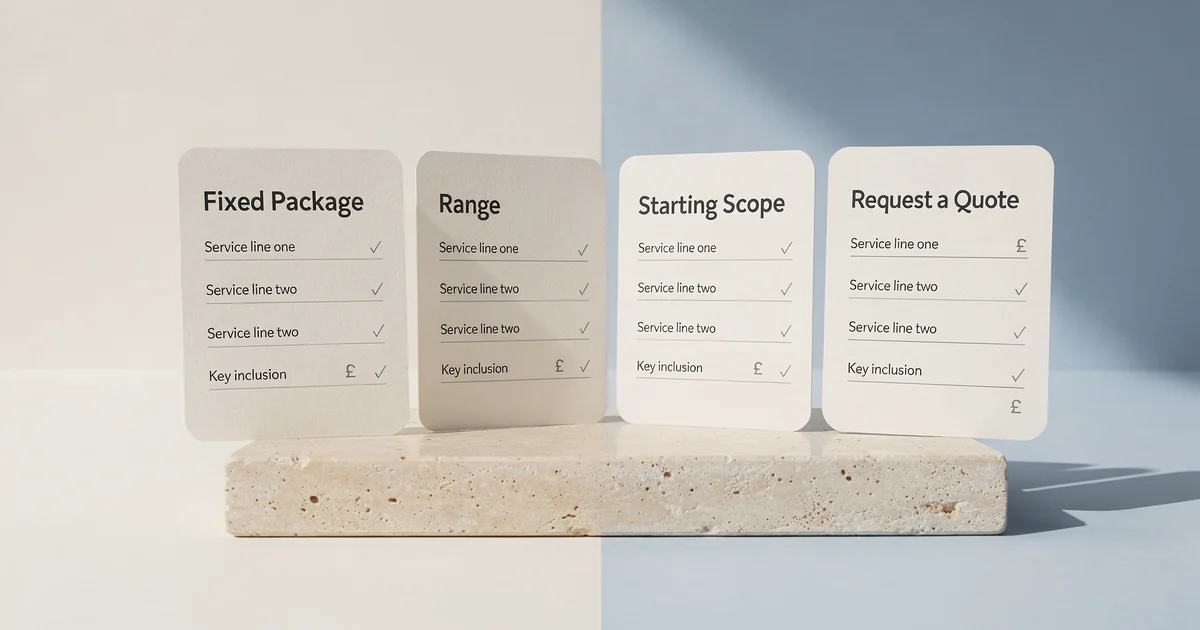
Compare the four common approaches before writing the pricing section. You can use different formats for different services on the same website.
| Format | Useful when | What the page must explain |
|---|---|---|
| Fixed fee | The deliverable and boundaries are repeatable | Included work, exclusions and any conditions |
| Range | Several common scopes have genuinely different costs | What moves the fee within or beyond the range |
| Starting price | A real, defined entry scope is available | Exactly what the starting option covers |
| Individual quote | Requirements vary too much for a useful single figure | Cost drivers, information needed and quote process |
A fictional training provider might show a fixed fee for a standard workshop and use individual quotes for a company-wide programme. The difference follows the work involved, not a belief that one pricing layout always converts better.
Do not force complex work into three packages because the design template has three columns. Equally, do not require a discovery call for a simple service your team sells repeatedly on the same terms.
Use Fixed Prices for Work You Can Define
A fixed price is useful when a buyer can recognise what they will receive and your team can deliver it within a clear boundary.
List the deliverables, relevant limits and what the customer must supply. For a review service, explain whether the fee includes a meeting, a written report, implementation or follow-up questions.
Our guide to how much a website costs in the UK gives a service-specific example of why a figure needs a defined scope.
State what happens if the requirements fall outside the package. A fair change process gives the customer a choice before extra work is charged. Do not rely on a vague small-print phrase to undo the main promise.
Keep payment timing separate from the total cost. A deposit is part of the payment arrangement; it should not be presented in a way that makes it look like the complete fee.
Make a Range Explain the Variation
A price range can be helpful when the work follows a familiar pattern but the scope varies. Give the reader concrete reasons for the variation.
Those reasons might include the number of locations, amount of material to review, complexity of existing systems or level of implementation required. Use factors that genuinely affect your estimates.
The guide to what UK SEO services cost provides an example where the work included needs explaining alongside the fee.
Avoid an enormous range that covers almost any project. If two common types of work have very different requirements, describe them separately rather than placing both under one unhelpfully broad figure.
Check the range against recent comparable quotes before publishing it. Exclude quotes only when their scope falls outside the service being described, and explain those exclusions. Keep the working evidence privately; you do not need to expose client details to make the public explanation honest.
Treat “From” Prices with Care
A starting price should represent an option that a suitable customer can genuinely buy. Define that option beside the figure, including the limits that explain why other projects cost more.
When explaining what brand identity design costs, distinguish the defined entry scope from a wider set of strategy and design deliverables.
Do not use the price of a tiny preparatory task to advertise a much larger service unless the distinction is clear. A visitor looking for implementation should not discover only after enquiring that the advertised fee buys a short introductory review.
The CMA's price-transparency summary explains that consumer pricing must be clear and complete, including unavoidable charges. Indicative or starting prices must not mislead about what they cover. Where a total cannot reasonably be calculated, check the guidance on the information needed to work it out.
Have a competent adviser review uncertain arrangements, particularly where a service includes variable compulsory charges. Design wording cannot repair an offer whose basic terms are unclear.
Make Quote-Led Pages More Helpful
“Contact us for a quote” is a next step, but it gives the buyer little help deciding whether to take it. Explain what the quote depends on and what happens during the assessment.
Tell the reader which information is useful at first contact. That might be the current website, number of locations, existing systems or desired outcome. Keep the request proportionate; a preliminary enquiry should not require a complete specification.
For product-led businesses with variable requirements, choosing a product catalogue website or online shop also means deciding when a quote is more useful than a checkout.
Where appropriate, explain how you separate discovery, implementation and ongoing support. If discovery is paid, say so before asking the person to book.
Our guide to content retainers and one-off projects shows why the commercial model changes what a buyer receives. A monthly service and a fixed project should not be compared from the headline fee without that context.
Check VAT and the Total the Customer Sees
Review the audience for each price claim. A general UK website may reach consumers and businesses, including businesses that cannot recover VAT.
ASA and CAP guidance on VAT says consumer-facing advertised prices should include VAT. VAT-exclusive claims have conditions, including who the claim addresses and a prominent statement of the amount or rate payable. Mixed audiences require care; a business-themed page does not automatically make a VAT-exclusive presentation suitable.
Ask your adviser to confirm the correct treatment for your offer and registration status. Then make the approved wording consistent across pricing cards, enquiry pages, downloadable documents and adverts.
The broader GOV.UK advertising guidance also emphasises accurate cost descriptions, including associated or ongoing charges. Keep optional additions distinguishable from costs a customer must pay to receive the advertised service.
Put Scope Close to the Price
Readers should not need to open several tabs to understand the main conditions. Put the most important inclusions and limitations beside the price or quote explanation.
Use plain labels. “Monthly support” needs a description of what support covers. “Unlimited” needs particular care if there are practical restrictions. If a service has a minimum term or a separate compulsory setup stage, make that clear where the reader evaluates it.
A custom website design project can give pricing information a sensible hierarchy without hiding detail. On mobile, check that the scope remains associated with the correct price when cards stack vertically.
Avoid using faint text or small print to carry a condition that changes the main offer. The page should be understandable at a normal reading size.
Expect Enquiry Volume and Quality to Behave Differently
Clear pricing may reduce enquiries from people whose budgets do not fit. It may also help a suitable buyer prepare for a more useful conversation. Neither outcome should be assumed without evidence.
Before changing the page, define what you want to observe. Useful measures include suitable enquiries, questions about price, time spent preparing unsuitable quotes and progression after the first conversation.
A conversion rate optimisation audit can help organise those checks around the full enquiry journey.
Do not declare success because the form-submission rate rises. A misleading low figure could increase enquiries while creating disappointment later. Conversely, fewer enquiries may still be a poor result if suitable customers were confused by the new wording.
Read a sample of the actual conversations, with appropriate access and privacy controls. Small businesses often learn more from the reasons behind a few enquiries than from a percentage based on very little traffic.
Review the Presentation Without Creating Confusion
Choose one service and make a clearly documented change. Record the old wording, new wording, publication date and reason.
Avoid changing the offer, advertising audience, form and pricing layout at the same time if you want to understand the effect. Where several changes are necessary, note that you cannot confidently attribute the result to pricing alone.
Check the complete page after release. Our website acceptance checklist is useful for testing mobile layout, links and the enquiry journey. Verify that private quotes and existing client agreements remain unchanged.
Assign an owner to review published prices and scope when the service changes. Outdated pricing can spread into old PDFs, social posts and automated messages, so include those surfaces in the maintenance list.
Choose the Smallest Useful Improvement
If you cannot publish a firm price today, begin by explaining the cost drivers and the quote process. If you can define a repeatable package, write its boundaries before designing the price card.
Ask a person unfamiliar with the service to explain what they think they would receive and pay. Their answer will show whether your wording is doing its job.
You can send us the service page if you want help presenting the offer clearly. Include the scope you currently sell and the questions prospects ask, without sharing private client quotes. We can then discuss the information the page needs before choosing a layout.
Frequently Asked Questions
Will showing prices reduce enquiries?
It may change both the number and suitability of enquiries, but there is no universal result. Review qualified conversations, price misunderstandings and progression as well as form submissions. A smaller number is not automatically better or worse.
Can a bespoke service show pricing without a fixed fee?
Yes. Explain the factors that affect the quote and the process for assessing requirements. A genuine range or starting scope may also help if the assumptions are clear and the presentation is appropriate for the offer.
Is a starting price enough?
Only if it accurately represents a real available scope and explains the relevant conditions. Check applicable pricing guidance, including unavoidable charges, and avoid presenting an entry task as though it covers the complete service.
Should UK website prices include VAT?
Consumer-facing advertised prices generally need to include VAT where payable. VAT-exclusive advertising has conditions relating to the audience and prominent tax information. Check current ASA guidance and obtain advice for your offer rather than assuming every business visitor can recover VAT.
How often should I review website pricing?
Review it whenever the service, costs or terms change, and assign a regular internal check. Include pricing cards, related pages, documents and automated messages so customers do not receive conflicting information.