
Key Takeaways
- Put buying information on the service page: who the service is for, deliverables, process, proof, costs, risks and the next step.
- Use blog posts for distinct questions that need more explanation, such as tutorials, comparisons, migration problems and changing industry guidance.
- AI-search systems do not need a separate “AI content” section. They need accessible, relevant and verifiable sources for the question.
- Link supporting articles to the service page and link the service page back to the most useful guides. Each page should have a clear job.
- Consolidate pages that compete for the same intent instead of publishing another variation of the same article.
Should content for AI search go on a service page or in a blog post? The answer depends on the decision the reader is making.
If the person wants to understand what you provide, what is included and whether to contact you, the answer belongs mainly on the service page. If they need a detailed tutorial, comparison or diagnosis before they are ready to choose a provider, a supporting article is usually better.
The strongest structure uses both. The article earns attention and explains the problem. The service page turns that understanding into a clear commercial next step.
Start with Search Intent, Not the Page Type
Search intent is the job behind the question.
Consider these queries:
- What does an AI integration service include?
- How much does AI automation cost in the UK?
- How do I connect an AI assistant to HubSpot?
- Which company can rebuild WordPress in Next.js?
- Why did my organic traffic drop after a website migration?
The first, second and fourth have obvious commercial elements. The third may need a detailed tutorial. The fifth is a diagnosis that can lead to a migration or SEO service after the reader understands the cause.
Do not choose a blog post simply because the query is long. Do not force every valuable phrase into a service page either. Write down:
- who is asking;
- what they already know;
- which decision comes next;
- how much explanation is required;
- which page on your site should own that decision.
Our answer engine optimisation guide explains how conversational questions can reveal the real information need.
What Belongs on a Service Page?
A good service page should let a serious buyer decide whether the offer is relevant enough to discuss.
Include:
A Direct Description
Name the service in plain language, the audience and the useful outcome. Avoid opening with a generic promise to transform or revolutionise the business.
Problems the Service Addresses
Use specific situations. For AI integration, that might be repetitive enquiry handling, disconnected data, manual document review or unreliable internal knowledge search.
Deliverables
State what the client receives: discovery workshop, process map, integration design, pilot, implementation, testing, training, documentation or support. Do not leave the whole offer inside a proposal form.
Process
Explain the main stages and decision gates. This helps a buyer compare providers and reduces uncertainty before an enquiry.
Suitability and Limits
Say who the service is for and when another route is better. An honest boundary builds more trust than claiming to suit every organisation.
Cost or Cost Factors
If a fixed price is not possible, describe the elements that change the scope. Give a sensible entry point or example only when it is current and accurate.
Proof
Use relevant case studies, methods, screenshots, testimonials and named experience. Explain context. A logo wall without the work is weak evidence.
FAQs
Answer the commercial questions people ask before contacting you. Keep the answers on the page rather than hiding everything in a sales call.
A Clear Next Step
Give the visitor a realistic action: book a short consultation, request an audit or send project details.
Our AI integration service is an example of a commercial destination. Supporting articles can explain individual questions, but the service page should remain the clearest source for the offer.
What Belongs in a Blog Post?
Use a blog post when the question deserves a focused answer that would overwhelm or distract from the service page.
Strong article types include:
Practical Diagnosis
“Why has my WordPress traffic dropped after a plugin update?” needs symptoms, checks and recovery steps. The reader may later need technical SEO or development help.
Detailed Comparison
“Next.js or WordPress for a service website?” can set criteria, explain trade-offs and show which choice fits different businesses.
Step-by-Step Process
A migration checklist or analytics setup guide can be substantial enough to stand alone.
Changing Guidance
AI regulation, platform documentation and search features change. A dated, reviewed article can explain the current position and link to primary sources.
Original Analysis
An anonymised dataset, experiment or field observation can become a valuable reference when the method and limitations are clear.
Early-Stage Education
Definitions and problem awareness can build familiarity before somebody searches for a provider.
The article still needs a reason to exist. A 1,500-word target does not justify 1,500 words of repetition. Cover a distinct decision better than the existing page.
How AI Search Changes the Question
AI-assisted search can combine information from several pages in one answer. A service page may supply the provider facts while a detailed article supplies a process or warning.
Google's AI features guidance says the normal Search foundations apply. Pages need to be indexable and eligible for a snippet. Google's AI optimisation guide emphasises unique, useful content and clear page experience rather than special AI files or secret markup.
That supports a familiar content principle: publish the answer on the page where it is most useful to a person, then make the relationship between pages clear.
OpenAI's crawler documentation likewise focuses on crawler access for ChatGPT search. It does not tell businesses to create duplicate AI-only pages.
Build a Service-Led Content Cluster
Start with one commercial hub.
For an AI integration service, the cluster might be:
- service page: what the integration service includes;
- cost guide: price factors and budget levels;
- buy-versus-build comparison: off-the-shelf tool or custom workflow;
- implementation guide: discovery to controlled launch;
- risk guide: data protection, security and human oversight;
- case study: a real process and measured outcome.
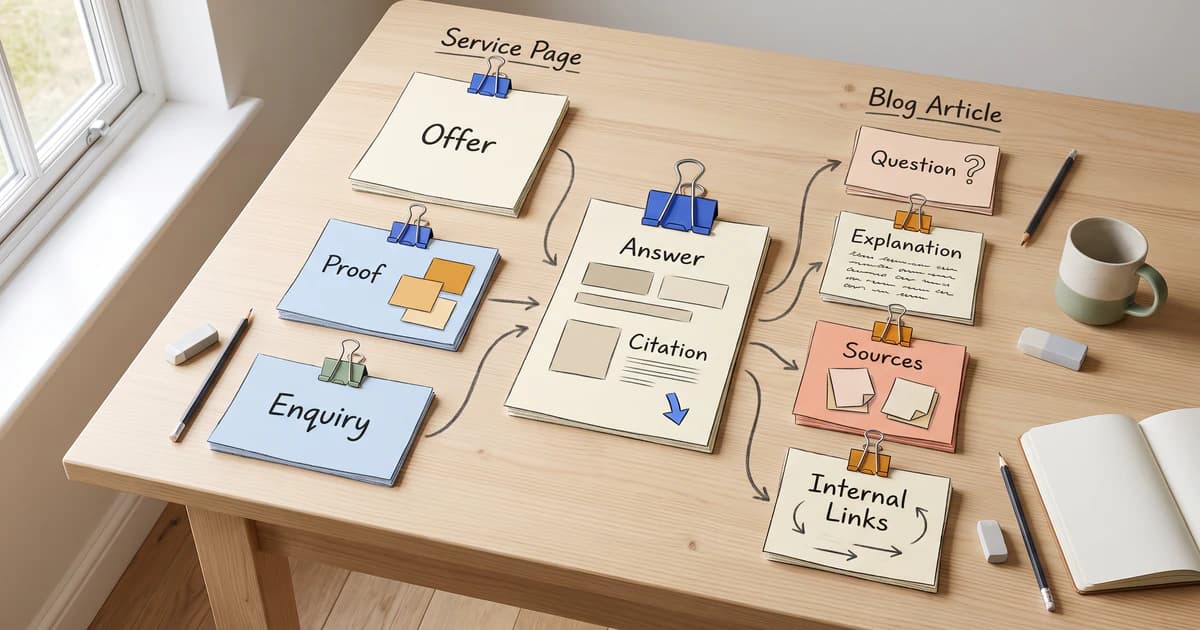
Each article answers a different question. All can link naturally to the service. The service page can link back to the two or three resources most useful during evaluation.
Our guide to custom AI versus off-the-shelf tools and the article on AI automation cost in the UK play different supporting roles. They should not repeat the full service description.
For a coherent programme, use content marketing services to plan clusters around real demand and SEO services to address technical access, search intent and internal linking.
Avoid Keyword Cannibalisation
Keyword cannibalisation is often described too simply as two pages using the same phrase. The real problem is two pages with no distinct purpose competing for the same search need.
Signs include:
- Google alternates between two URLs for the same query;
- both pages rank weakly and contain similar sections;
- internal links use the same anchor for different destinations;
- the service page has become a thin sales version of the article;
- the article repeats prices, process and deliverables without adding a separate decision.
Do not merge pages merely because they share words. A service page and a detailed tutorial can both discuss AI integration while serving different needs.
When intent overlaps heavily:
- compare impressions, clicks, links, enquiries and page quality;
- choose the URL that should own the question;
- move any valuable unique material;
- rewrite the surviving page into one coherent answer;
- update internal links;
- redirect a retired URL to the most relevant surviving page;
- request reindexing and monitor the change.
Avoid redirecting unrelated articles to the home page.
Decide with a Simple Page-Placement Test
Ask five questions.
1. Does the Answer Help Someone Buy This Specific Service?
If yes, the key answer belongs on the service page, even if a longer article supports it.
2. Would the Detail Distract from Evaluating the Offer?
If a tutorial needs dozens of steps or code examples, keep it in an article and summarise the relevant point on the service page.
3. Does the Topic Change Frequently?
Fast-changing platform guidance often benefits from a dated article with source links and a review date. Keep stable service facts on the commercial page.
4. Is There Already a Strong Page?
Improve it before adding a competitor. Search your own site, review Search Console pages and map internal links.
5. What Should the Reader Do Next?
If the natural next step is to compare providers or request help, connect the content to a service. If the article solves the whole problem safely, give the reader the complete answer without an artificial sales gate.
Use Internal Links as Explanations
Internal links should tell people and crawlers how pages relate.
Use anchors such as:
- compare our AI integration service;
- see the WordPress migration checklist;
- understand the factors affecting SEO cost;
- review the AI data-protection guide.
Avoid “click here” and avoid putting ten service links into every paragraph. Link when the destination answers the next likely question.
From a service page, add a small “Useful guides” section. From an article, introduce the service only where the reader may need implementation help. A final contact option is enough for many posts.
Put Experience and Evidence in the Right Place
Google's guidance on helpful, reliable, people-first content encourages clear sourcing, expertise and content made for a real audience.
For a service page, evidence can include:
- who does the work;
- a current process;
- tools and platforms genuinely supported;
- case studies and constraints;
- client reviews with permission;
- delivery and support terms.
For an article, evidence can include:
- screenshots from a real test;
- a method that readers can reproduce;
- primary-source links;
- practical examples;
- limitations and update dates;
- named authorship and review responsibility.
Do not invent first-hand experience to make an article sound authoritative. If the post is a researched guide, say so through clear sources and careful claims. If it contains a client example, obtain approval and remove sensitive details.
Measure Each Page by Its Job
A blog post may be successful when it earns relevant impressions, citations, links or assisted conversions. A service page should be judged more directly on qualified enquiries and progression.
Track:
- query and page visibility;
- AI citations and mentions from a documented sample;
- referral sessions;
- internal clicks from article to service;
- form starts and completed enquiries;
- self-reported discovery source;
- lead quality;
- eventual outcome.
Do not declare an informational post a failure because it did not receive last-click leads. Do not celebrate a service page for impressions if nobody understands the offer.
Our analytics reporting service can connect these page roles in one measurement plan.
A Practical Content Audit
Create a sheet with:
- URL;
- page type;
- primary audience;
- main question;
- intended next action;
- target service;
- Search Console queries;
- AI prompt visibility;
- internal links in and out;
- conversion or lead evidence;
- keep, improve, merge or remove decision.
Review one service cluster at a time. Start with the service most important to the business, not the easiest article to write.
You may find that the next best content task is not another blog post. It may be rewriting a vague service page, adding a missing comparison, documenting a real case or merging three weak articles.
Frequently Asked Questions
Should a service page target informational questions?
Yes, when the answer helps a buyer evaluate that service. A service page can explain process, deliverables, suitability, costs, risks and FAQs without becoming a general textbook. Broader tutorials, industry news and early-stage education usually belong in supporting articles.
Can a blog post rank instead of my service page?
It can, especially when the query is informational and the article answers it more directly. That is not automatically a problem. Link the article to the relevant service, make the service page commercially useful and avoid having both pages compete with near-identical copy.
Do AI-search systems prefer blog posts or service pages?
There is no documented universal preference. Systems retrieve sources that help answer a particular question. A service page may be suitable for provider, deliverable or cost questions; an article may be better for a tutorial or comparison. Page quality, access, evidence and relevance matter more than the folder name.
How many blog posts should support one service page?
Use the number needed to cover genuinely different customer questions. For a small business, three to six strong supporting pieces may be more useful than dozens of overlapping articles. Review Search Console, sales calls and existing pages before creating more.
When should I merge a blog post into a service page?
Consider merging when both pages answer the same intent, neither has a distinct role and the article adds commercially useful detail that belongs in the service decision. Preserve valuable sections, choose the strongest URL, update internal links and use a relevant permanent redirect if a URL is retired.
Audit the Existing Cluster First
The service-page-versus-blog decision is not really about AI. It is about helping a person complete the next decision without creating duplicate, disconnected content.
Build the commercial page first. Add articles for genuinely different questions. Link them as a useful journey and measure each page according to its role.
If your website has years of overlapping articles and unclear service pages, contact MattDarm. We can map the current content before creating another batch.